
The Basic Eight by Daniel Handler
A Novel
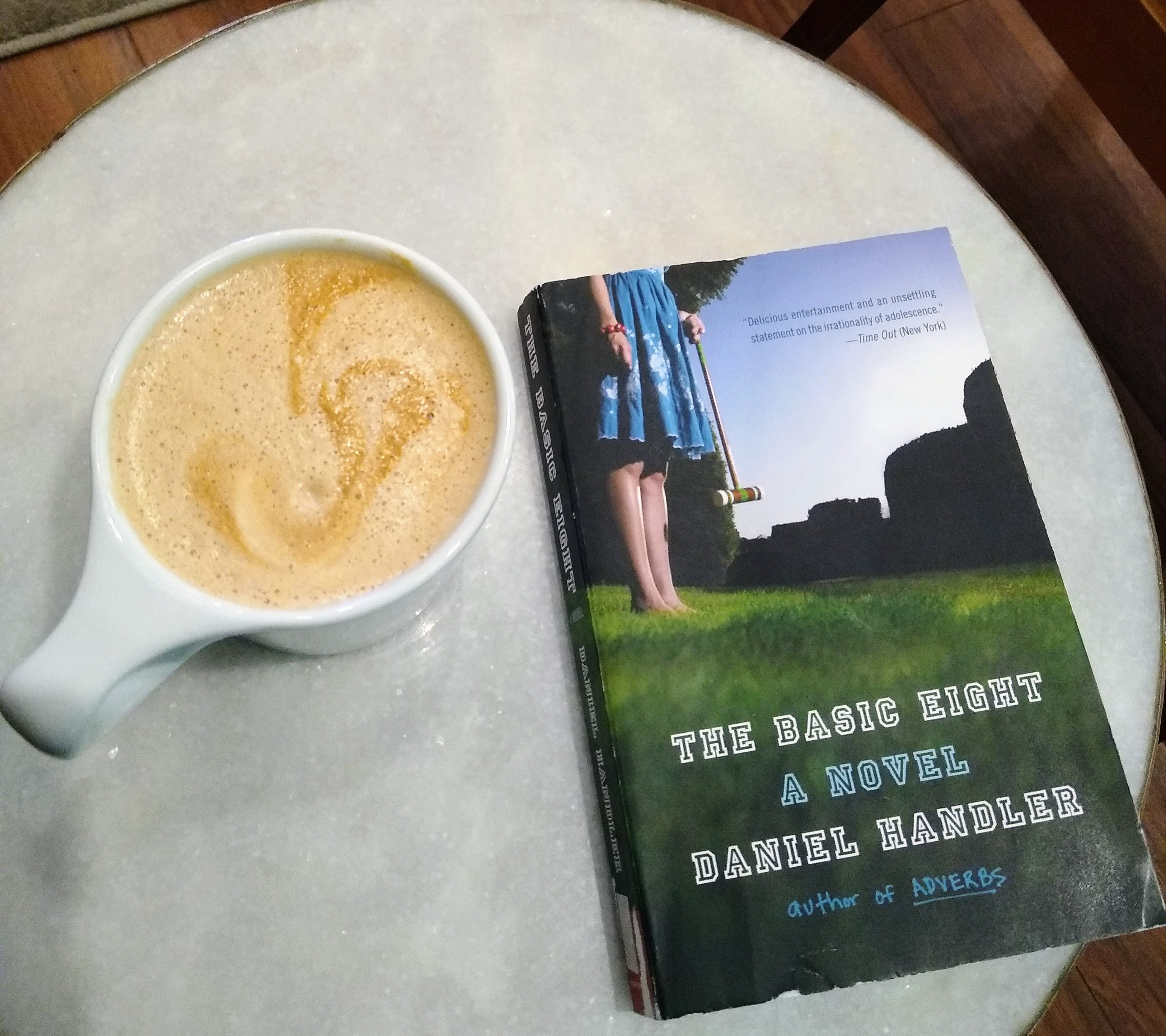
Title: The Basic Eight
Author: Daniel Handler
Publisher: Harper Perennial*
Publication Year: 2006*
ISBN: 9780060733865
Rating: 5 stars
*first published in the US in 1999 by Thomas Dunne Books
Growing up (and let’s be honest, still today) I was a huge Lemony Snicket fan. A Series of Unfortunate Events (ASoUE) was my jam. I loved the resourceful Baudelaire kids and I loved how smart and funny the books were. It was probably the first thing I read that had witty wordplay, double entendres, and literary allusions *chef’s kiss*. Of course at 10, I didn’t know any of the terminology for that. ASoUE defined words and idioms in a way that didn’t feel like Snicket was talking down to or condescending to readers. I loved that Snicket himself was a character in the story, which made it seem more real, even when I knew it wasn’t. The books felt entertaining and intellectually stimulating in a way that a lot of other middle grade books didn’t at that time. I’ve re-read the series twice as an adult, and it just gets better with age. Every time I read it, I understand new references and allusions that I had missed the previous times. I really feel that Lemony Snicket is a literary genius. So, of course, I also love Daniel Handler, the man behind Lemony Snicket.
Handler’s adult work, as you might imagine, is pretty different from his work for children. It often veers toward the absurd and sometimes is weirdly sexual. I don’t think those things necessarily take away from the enjoyment of the novel, but it definitely isn’t what you would expect if you are only familiar with Handler’s children’s books. Specifically I am thinking of Adverbs and Watch Your Mouth respectively. I tend to prefer Handler’s adult books that are centered on teenagers (The Basic Eight, Why We Broke Up, and We Are Pirates) because they combine a lot of the hallmarks and themes of ASoUE with more adult plots and are generally a little less risqué (though not always, there is a TW for sexual assault for this book and it’s mentioned in this review).
The Basic Eight is everything that I wanted The Secret History by Donna Tartt to be (I know it’s a well-written and much loved book—just not by me). The book is “written” and narrated by Flannery Culp, a young adult girl who bludgeoned her crush to death with a croquet mallet because he didn’t like her back. She is in prison for her crimes, but going through and editing her journals from her senior year of high school, when the crime took place, for publication as a true crime novel. For a variety of reasons, Flannery is an unreliable narrator. She makes no secret of the fact that she is going back through these journal entries and cleaning them up. Modern day Flannery inserts her own commentary as if Flannery of the past already knew what she now knows. Flannery is very open about what happens from the beginning, so none of this is a spoiler. The journals begin in August before senior year, when Flannery is in Italy with her parents and sending letters confessing her love to her crush back home, Adam State. When Flan gets back home and Adam doesn’t call her, she isn’t sure where they stand. When Adam seemingly leads her on, then starts dating her friend Kate, then dumps Kate, then leads Flan on again, it’s just too much. When she gets drunk at a party, she sees the perfect opportunity to take her revenge.
Flannery and her seven friends (the eponymous Basic Eight) are all seemingly wealthy, precocious, pretentious, intellectuals. They have an Opera Club where they get together to listen to and discuss operas hosted by their French teacher and confidante, Millie. They have regular fancy dinner parties, drink copious amounts of coffee, go to the theater, and attend viewings of Marlene Dietrich films. They drink a lot of alcohol, but seemingly only top shelf stuff. They also experiment with absinthe, which in the book is a lot more like what you hear about in the stories of fin de siècle artists, and nothing like my experiences of drinking absinthe in the modern day. It’s not hard to imagine the members of the Basic Eight going to college and turning into Charles and Camilla, or Francis, or Henry (but probably not Bunny).
This book is dark, but it does lack some of the dark academia hallmarks that we see in The Secret History. Like many novels set in high school, school often seems like merely a place where the main characters all come into contact with each other regularly rather than an actual part of their lives. The characters all mention being stressed about applying to colleges, but Flannery often cuts class and homework is only mentioned in passing. Some of this is because in her descent into madness so to speak, she becomes a bad student. The other characters also seem very nonchalant about attending class or doing any work other than scheming, pining over love interests, or party planning. As a former teacher, I did catch myself wondering where the truancy officer was or why no one from the school had contacted anyone’s parents about the poor grades and worse attendance.
Which brings me to another thing that I really liked in this book: like in ASoUE, the adults in this novel range from wildly incompetent to straight up villainous. They are ineffectual, unhelpful, or altogether absent. Other than Millie (who is the mother of group member Jennifer Rose Milton, but more of a friend than a mom) and Satan, their nickname for another member’s mother, none of the group members seem to have any parental supervision. Flan’s teachers either feed her platitudes like she is a child, or in one case, sexually assault her. Their Vice Principal is focused on telling them he’s a “pal” first and dealing with actual issues never and their Principal is clueless and inaccessible. If this were a true story, it would be shocking and horrifying how they are let down by every adult they encounter, however, because it is fiction, I really love it. I think it captures the way one feels as an older child or teenager when they start to notice that the adults around them aren’t infallible and feel that they are not taken seriously by these adults when they have something of value to say. Hopefully, in hindsight, one is lucky enough to look back and see that they did have adults in their life that cared and were doing their best, but it doesn’t always feel that way in the moment, and Handler captures that feeling by making it reality for his characters.
As usual, Handler’s dark humor shines through in this novel. This book had me laughing out loud in public and laughing until I cried. I know not everyone appreciates his type of humor, but I certainly do. There was a twist at the end that I saw coming pretty early in the book. I think it adds interest to the story, but at the same time is somewhat unnecessary due to the way the story is being told. It creates a red herring in regards to who killed Adam State, but since Flannery is honest from the beginning that she committed the murder, it’s not a particularly effective red herring. While Flannery is unreliable, she is not an unsympathetic character. I never beat an ex to death with a croquet mallet, but I did relate to the emotions that took her to that level. She goes (what is hopefully) an unusual direction with her her angst and emotion, but the emotions are familiar to someone who was once a teenage girl.
In closing, what I think is a fun fact: Daniel Handler inspired the title of this blog. He and Michelle Tea did an author event for the release of his newest book, Poison For Breakfast and they had a portion where the audience was able to ask questions unrelated to the book. My question was what I should call this blog. He suggested opening a nearby book to a random page and finding a random line and taking it from there. So the title is based on a line from 300 Arguments by Sarah Manguso (I edited it a bit to make it make sense) and inspired by Daniel Handler. I have also met Handler and he was very funny and nice in person.
I am learning to love dark academia novels. I will add this to my list. Have you heard of I Have Some Questions for You by Rebecca Makkai? It sounds like it has potential in this subgenre.